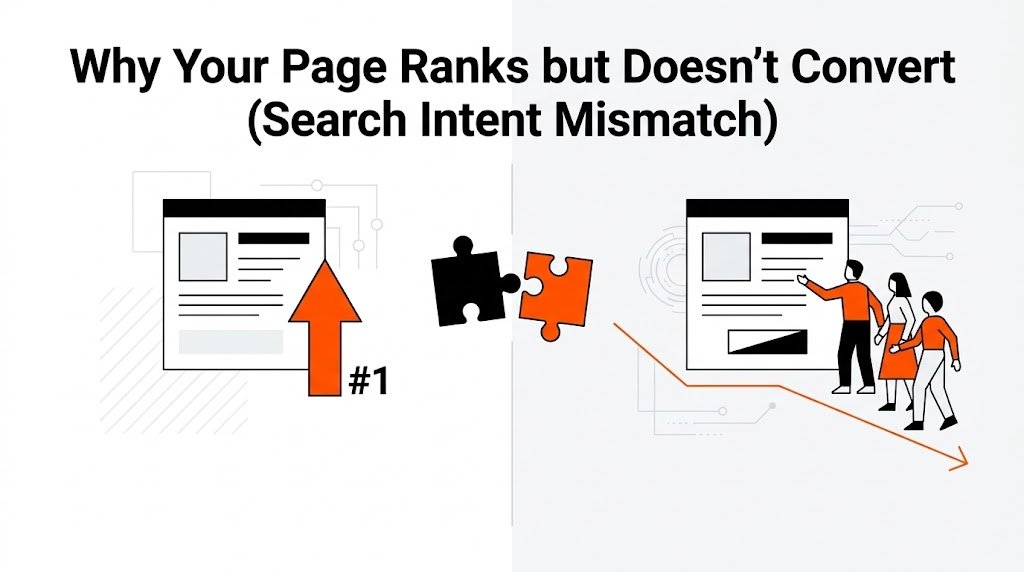
This is a specific, confusing problem, and it trips up site owners more than almost anything else in SEO. The keyword tracking tool shows the page sitting on page one. Analytics confirms real traffic is arriving. And yet the page produces almost nothing — no form fills, no calls, no purchases. Something is clearly working, since the page ranks, and something is clearly broken, since none of that traffic turns into anything.
The most common explanation, more common than people expect, is search intent mismatch. The page ranks for a keyword, but it doesn't actually give the visitor what they came looking for. Google can reward relevance without the page fully satisfying the person behind the click, at least for a while, and that gap between ranking and satisfying is where conversions quietly disappear.
What Search Intent Actually Means, Beyond the Textbook Definition
Search intent gets defined in most SEO guides as a category: informational, navigational, commercial, or transactional. That framework is useful, but it's a bit too abstract to diagnose a specific underperforming page. The more useful question isn't "what category does this keyword fall into," but "what does the person typing this specific phrase expect to see in the first ten seconds on the page."
Someone searching "how much does a website redesign cost" wants a number, or a range, and a sense of what drives that number up or down. They are not, at that moment, looking for a company's origin story or a general essay on the importance of good design. A page can be well written, accurate, and genuinely informative, and still fail this specific visitor if the thing they wanted is buried under content they didn't ask for yet.
This is the diagnostic core of intent mismatch. The page isn't necessarily bad. It's answering an adjacent question instead of the one actually being asked.
Why Google Still Ranks a Page That Doesn't Fully Satisfy Intent
This confuses a lot of people, understandably. If Google is supposed to reward the best answer, why would a page that doesn't fully match intent rank at all?
The honest answer is that ranking signals and satisfaction aren't identical, and the gap between them is often temporary rather than permanent. A page can rank based on topical relevance, decent on-page structure, and some domain authority, while still underperforming on user satisfaction metrics that take longer for Google to fully weigh in, or that show up more in engagement signals over time than in the initial ranking decision. In many cases, a page in this position holds its ranking for a while and then slides down as Google's systems pick up on weak engagement — short visit duration, quick returns to the search results — rather than losing the position immediately.
There's also a simpler explanation that gets overlooked: sometimes there just isn't a better-matched page competing for that term yet. A mediocre intent match can still outrank an even weaker set of competitors. That doesn't mean the mismatch isn't costing conversions in the meantime. It just means the ranking itself isn't in immediate danger, which is exactly why this problem can sit unnoticed for months.
The Four Intent Categories, and Where Mismatch Actually Happens
Informational intent is someone trying to learn something, not buy anything yet. A mismatch here usually looks like a page that assumes too much commercial readiness, jumping into pricing and calls to action before answering the actual question the searcher came with. This can hurt conversions in a roundabout way: if the informational page bounces the visitor quickly because it feels like a sales pitch instead of an answer, that visitor doesn't come back later when they're ready to buy.
Navigational intent means someone is searching for a specific site or page they already have in mind, often a brand name or a specific product. Mismatch here is rare but happens when a similarly named competitor or an unrelated page outranks the actual destination the searcher wanted.
Commercial investigation intent is someone comparing options — not ready to commit yet but narrowing down choices. A common mismatch is a page written as pure informational content when the searcher actually wants a comparison, pricing context, or a clear sense of how this option stacks up against alternatives. "Best" and "vs" style queries fall here, and a page that doesn't actually compare anything fails this intent even with a lot of accurate general information.
Transactional intent is the clearest one to get wrong, because the cost is immediate. Someone ready to buy or sign up hits a page that's still educating them, still building a case, still working up to a call to action three screens down. This is the most expensive version of intent mismatch, since this visitor was the closest to converting and the page let them slip away by making them work too hard to find the next step.
How to Actually Diagnose This on Your Own Site
Start with pages that have decent rankings and traffic but a conversion rate well below similar pages on the site. A page ranking on page one with reasonable monthly visits and almost no leads is a strong candidate. A page with no traffic at all has a different problem — visibility, not intent.
Once you've found a candidate, search the exact keyword the page ranks for and look honestly at what else shows up on page one. If every other result in that top ten is a comparison table or a pricing breakdown, and your page is a long-form educational article with pricing mentioned once near the bottom, that's a visible mismatch. Google's own top results are a reasonably reliable signal of what it currently believes searchers want for that specific phrase, since those pages are already succeeding on some combination of relevance and engagement.
Behavioral data adds another layer. A high bounce rate combined with a short average time on page suggests visitors aren't finding what they expected quickly enough to stay. Scroll depth data, when available, can show whether visitors are reaching the part of the page that actually matches their intent, or leaving before they get there. If the useful, intent-matching content sits at paragraph fifteen and most visitors never scroll past paragraph four, the content technically exists but isn't doing any work.
Fixing the Mismatch Without Starting Over
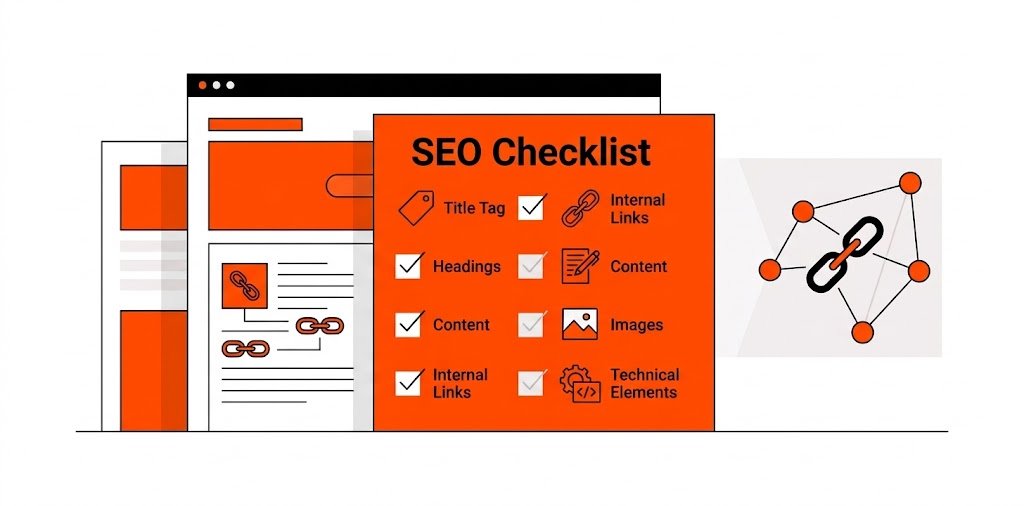
The fix is rarely deleting the page and writing something completely new. More often, it's restructuring what's already there so the intent-matching content appears earlier, and the supporting material follows rather than leads. The practical, page-level steps — titles, headings, content ordering, and the rest — are exactly what our on-page SEO checklist walks through with before/after examples.
For a page mismatched toward commercial or transactional intent, that usually means moving pricing information, comparison points, or a clear next step higher up on the page, ahead of background explanation the visitor didn't specifically ask for yet. For a page mismatched toward informational intent, it can mean pulling back on premature sales language and making sure the actual question gets a direct, early answer before anything else.
This depends on the keyword and the page's role in the broader site. A page meant to sit early in someone's research process shouldn't be forced into a transactional structure just because a competing page ranks that way, since that mismatch would just run in the other direction. The fix is matching structure to what the specific query actually signals, not defaulting to one universal template for every page on the site regardless of where the visitor actually is in their decision.
A Word on Patience
Restructuring a page for intent doesn't usually produce an overnight ranking change, since Google needs to recrawl and re-evaluate the page, and engagement signals take time to accumulate under the new structure. What often changes faster is the conversion rate itself, since visitors arriving at a page that finally answers their actual question tend to act on it sooner, even before any ranking movement shows up.
It's also worth being honest that not every low-converting, high-ranking page is an intent problem. Weak trust signals, a confusing call to action, or a slow-loading page can all suppress conversions even when intent is matched correctly — a slow page, in particular, is a technical issue better diagnosed through technical SEO audits. Intent mismatch is the most common explanation for this specific pattern, ranking well with almost no conversions, but it's worth ruling out the simpler, more mechanical issues first before assuming the entire page needs restructuring.
FAQ
How do I know if my problem is intent mismatch or something else, like weak CTAs or slow load times?
Check the mechanical issues first, since they're faster to rule out. Confirm the page loads quickly, the call to action is visible and clear, and trust signals are present. If those all look fine and the conversion rate is still well below similar pages on the site, intent mismatch becomes the more likely explanation.
Will fixing intent mismatch cause my rankings to drop?
It shouldn't, as long as the page still covers the topic thoroughly. Restructuring content to answer the actual question earlier, rather than removing relevant information, tends to improve engagement signals over time rather than hurt them. Rankings may take a little time to reflect the change either way.
Does this apply to informational content, or only commercial pages?
It applies to both, though the mismatch looks different. On informational pages, mismatch often means pushing sales language too early. On commercial or transactional pages, it usually means burying pricing or a clear next step too far down the page.
How long should I wait after restructuring a page before judging results?
Conversion rate often shifts faster than rankings, sometimes within days to a couple of weeks, since it depends on visitor behavior rather than Google recrawling and re-evaluating the page. Ranking changes can take longer and depend on how frequently that page gets crawled.
Can a page have the right intent match and still convert poorly?
Yes. Intent mismatch is one of the more common explanations for this pattern, but it isn't the only one. Weak trust signals, an unclear or missing call to action, or slow page speed can all suppress conversions even on a page that answers the right question correctly.
If you'd rather have a team diagnose why your pages aren't converting — intent review included — our on-page SEO service starts with exactly this kind of analysis.
Related Guides
More from the same part of the roadmap — same category first, newest first.