Ask most site owners what happened to their last SEO effort and you'll hear some version of the same story: a freelancer produced a big audit, a few things got fixed, momentum faded, and nobody's quite sure what happened after that. The traffic chart still has the same slope it had eight months ago.
The usual diagnosis is "we needed better SEO." The real problem is usually simpler — there was no process. Just a list of tasks, done in whatever order felt most urgent that week, with no clear way to tell if any of it was working.
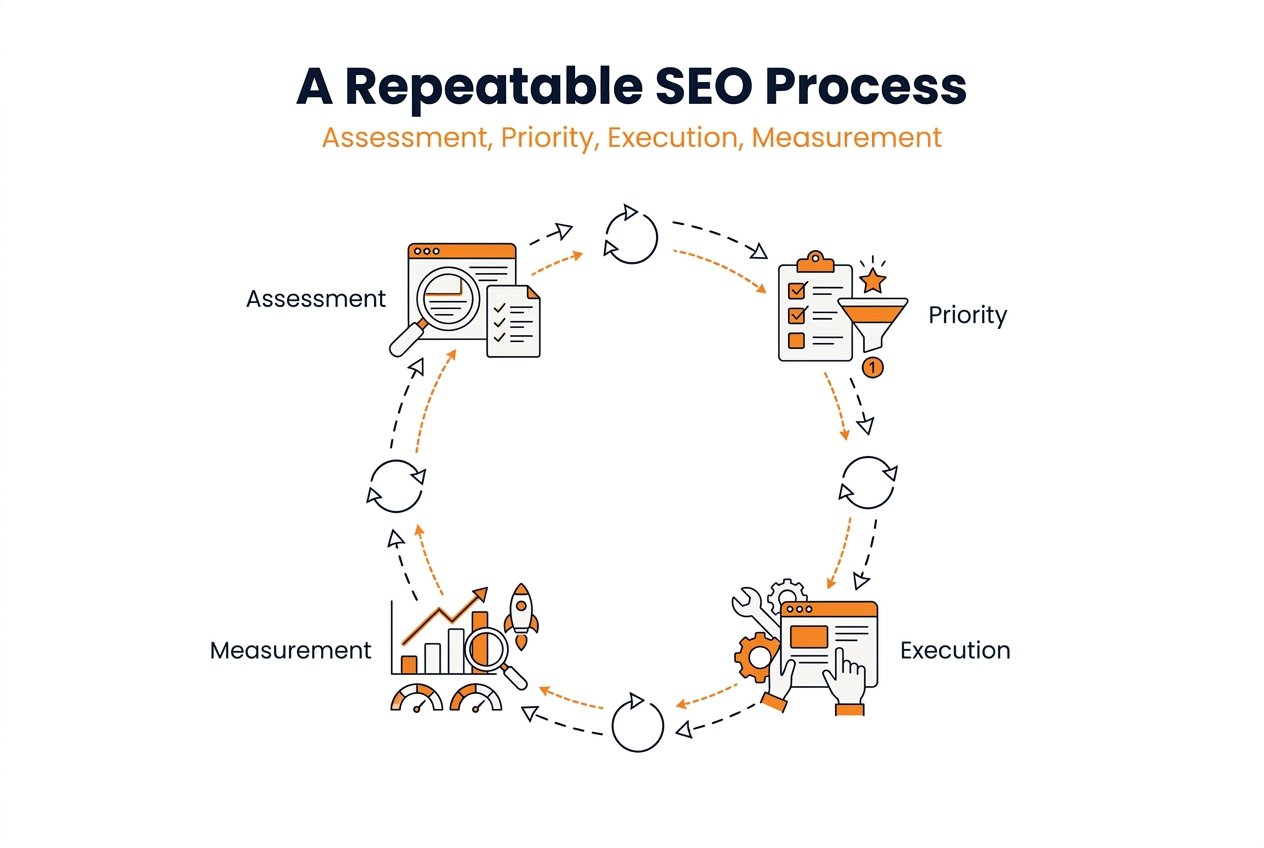
A repeatable process fixes that. Not a one-time audit, a cycle: Assessment, Priority, Execution, Measurement, repeated on a schedule. Here's what each stage actually involves, and where most SEO efforts quietly fall apart.
The Problem Isn't a Lack of Ideas
Run any reasonably sized site through a full technical and content audit and you'll get somewhere between thirty and fifty flagged issues. Broken canonicals, thin category pages, a Core Web Vitals score that's been red for a year, orphaned blog posts, duplicate title tags, a sitemap that still references pages that were deleted in 2023.
None of that is the hard part. Finding problems is mechanical — a decent crawler will surface most of it in an afternoon. The hard part is knowing which five of those fifty issues are actually worth a developer's time this month, and having a process that gets them shipped instead of filed away in a spreadsheet nobody reopens.
That's what these four stages are for.
Stage 1: Assessment
Assessment means reviewing the site's technical condition, its existing content, and the competitive landscape — before recommending anything. Not after. The order matters, because recommendations made before assessment are usually just a generic checklist with the client's name swapped in.
A real assessment answers a specific set of questions:
Can search engines actually crawl and index the pages that matter, or is budget being wasted on parameter URLs, filtered pages, and staging environments that leaked into the index?
Where does existing content overlap with itself, cannibalizing rankings for the same query across multiple pages?
What are competitors ranking for that this site isn't, and is that gap winnable or a losing fight against sites with ten times the domain authority?
Is the content structured in a way a search engine — or an AI system trying to summarize it — can actually parse and trust?
The output of this stage isn't a fifty-item checklist. It's a clear picture of where the site currently stands, organized by the three things that cap organic performance: what can be crawled, what's actually relevant, and what's considered trustworthy.
Stage 2: Priority
This is the step most agencies skip, and it's the one that separates a genuinely useful audit from a document that gets skimmed once and forgotten.
Prioritization means ranking every finding by expected impact against implementation effort — not listing issues in the order a crawler happened to discover them. A broken canonical tag on the homepage and a missing alt attribute on a blog image might both show up as "errors" in an audit tool. They are not remotely the same priority.
A useful way to sort findings: high impact and low effort gets fixed now; high impact and high effort gets planned and scheduled; low impact and low effort gets batched later; low impact and high effort usually gets skipped.
Most of the value sits in the top-left quadrant — high-impact fixes that don't require a development sprint. A redirect chain slowing down your highest-traffic landing page. A title tag that's been truncated in search results for a year. These get fixed first, not because they're easy, but because fixing them is the fastest path to a measurable result, and early wins are what keep a program funded past month three.
The top-right quadrant — high impact, high effort — is where a real plan matters: a site architecture rework, a content consolidation project, a Core Web Vitals overhaul. These need scheduling, not abandonment, which is what usually happens to line items that look expensive on day one.
Stage 3: Execution
A plan that isn't implemented is a document. Execution is where most SEO work actually breaks down, and it usually isn't for lack of will — it's for lack of specificity.
"Improve page speed" is not an instruction a developer can act on. "Defer the three render-blocking scripts on the homepage identified in the audit, and convert the hero image to WebP" is. The difference between an audit that gets implemented and one that sits in a shared drive is almost always the difference between vague direction and a clear specification.
Execution takes one of two forms: direct implementation — fixes get made by whoever owns the SEO work, without waiting on another team's sprint calendar; or specification handoff — when a development team owns the build, they get a spec precise enough that there's no back-and-forth about what "fix the sitemap" actually means.
Either way, vague instructions are what stall projects. They don't get rejected — they get deprioritized indefinitely, because nobody wants to be the one asking what "improve internal linking" means in practice.
Stage 4: Measurement
Measurement means tracking progress against metrics that were agreed on before the work started — not picking whichever number looks best after the fact.
The honest version of this stage includes admitting when something isn't working. A ranking that hasn't moved in six weeks after a content refresh, a backlink campaign that added links but no referral traffic, a technical fix that shipped but didn't move Core Web Vitals — these are worth saying out loud in month two, not discovering in a quarterly review that was mostly written to look productive.
A few things worth tracking beyond the generic "traffic went up" metric:
Query-level rankings for the specific terms the priority list was built around, not just overall visibility.
Crawl and index coverage, to confirm technical fixes actually changed how the site is being read.
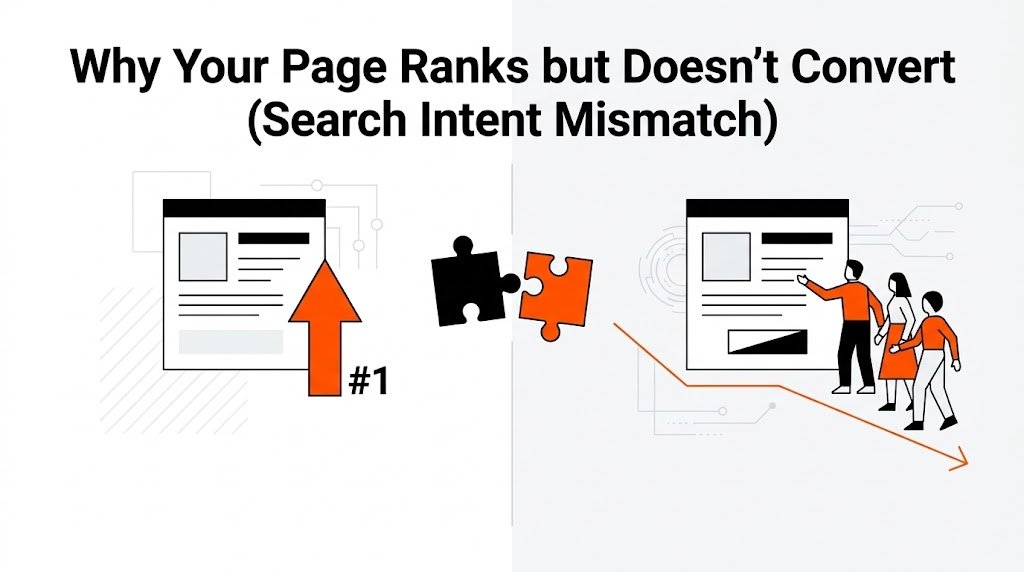
Conversion or lead metrics tied to organic traffic, since a page can rank and still fail to convert if it never matched what the searcher actually wanted.
Whether the fix caused a regression elsewhere — SEO changes interact, and a win in one area can quietly cost you in another.
Measurement isn't the last step in a line. It's what turns Assessment into a return trip instead of a one-time event.
Making It Repeatable
The four stages only work as a cycle. Assessment feeds Priority, Priority feeds Execution, Execution feeds Measurement, and Measurement becomes the input for the next round of Assessment. Run once, this is an audit. Run on a schedule — monthly for a fast-moving site, quarterly for a stable one — it's a program.
This is also why a repeatable process beats an occasional overhaul, even when the overhaul is well executed. A full rebuild every eighteen months finds every problem it's aimed at and misses everything that accumulates in between. A process that runs continuously catches drift early: the new page template that quietly broke schema, the content team that started duplicating an old topic without realizing it, the plugin update that added three seconds to load time.
Incremental, tracked, and repeated is a less exciting pitch than "complete SEO overhaul." It's also the version that actually holds up a year later.
FAQ
How long does one cycle through Assessment, Priority, Execution, and Measurement take?
It depends on site size and how much needs fixing, but a first cycle typically runs four to eight weeks from initial assessment to a first measurement checkpoint. After that, cycles get shorter because the foundational issues are already handled.
How many issues should actually make it into the priority list?
Fewer than most audits suggest. A typical audit surfaces thirty to fifty findings; realistically, five to ten belong in any single execution cycle. The rest get scheduled for later rounds or discarded if the impact doesn't justify the effort.
What if Measurement shows a fix didn't work?
Say so, then figure out why. A fix that doesn't move the needle usually means either the wrong problem was prioritized, the change wasn't fully implemented, or an external factor — an algorithm update, a competitor's move — offset the gain. All three are useful to know, and none of them are a reason to hide the result.
Can this process work for a small site with a limited budget?
Yes — the stages scale down rather than disappear. A small business might run one execution cycle a quarter with three or four fixes instead of ten, but the same order — assess, prioritize, execute, measure — still applies. Skipping straight to execution without assessment and priority is exactly what leads to the scattered, unmeasurable effort this process is meant to fix.
Is this process any different once AI Overviews and chatbots are part of search?
The stages stay the same; some of what gets assessed and measured expands. Assessment now includes whether content is structured clearly enough for an AI system to parse and cite, not just whether it ranks. Measurement can include AI citations alongside rankings. The underlying discipline — assess, prioritize, execute, measure, repeat — doesn't change because the channel did.
Most SEO projects don't fail from a lack of expertise. They fail from a lack of process — no clear order, no accountability for what gets implemented, and no honest check on whether it worked. Assessment, Priority, Execution, and Measurement, run as a repeating cycle rather than a one-time event, is what turns "we tried SEO once" into a program that keeps producing results.
If you want a second opinion on where your current process is breaking down — or you don't have one yet — start with a free SEO assessment. We'll tell you which five things are actually worth fixing this quarter, not hand you a fifty-item list and disappear.
Related Guides
More from the same part of the roadmap — same category first, newest first.