Ask five SEO agencies to quote the same website and you'll get five different numbers, sometimes off by a factor of ten. That spread makes people suspicious, understandably. It looks like the industry either doesn't know what it's doing or is making up prices on the spot.
Neither is usually true. The real reason quotes vary that much is that "SEO" isn't one service with one price. It's a label covering work that ranges from a two-hour fix to a year-long, cross-team rebuild. Asking "what does SEO cost" without specifying scope is a bit like asking "what does construction cost" — the honest answer is always another question: for what?
Here's what actually determines the number on a quote, and how to tell whether a given price matches your situation.
Why "Affordable" and "Premium" Are the Wrong Questions
Site owners often frame the search as a choice between an affordable agency and a premium one, as if those were two tiers of the same product. They're not. The honest answer to "are you affordable or premium" is that it depends on scope.
A small business that needs a handful of foundational technical issues fixed and a realistic content plan for three or four target keywords is a fundamentally smaller engagement than an enterprise site managing thousands of URLs across multiple markets, with a development team and a CMS with its own quirks. Pricing those two situations the same way would mean overcharging one of them.
What should stay consistent between a $500/month engagement and a $15,000/month one isn't the price — it's the honesty behind it. Pricing tied to the actual work involved, not a package designed to look comprehensive on a sales page.
What Actually Drives the Number
A handful of factors explain most of the variation in SEO pricing, more than agency reputation or geography ever will.
Site size and technical complexity. A 40-page brochure site and a 40,000-page ecommerce catalog are not the same project, even if both technically "need SEO." Crawl budget, templated fixes, and the sheer surface area of things that can go wrong all scale with page count.
How much technical debt has already accumulated. A site that's been neglected for three years — broken redirects stacked on broken redirects, a sitemap nobody's touched since a platform migration, schema that stopped matching the page templates — costs more to fix than a site that's been reasonably maintained, independent of how big either one is.
Competitive difficulty. Ranking for a low-competition local service term is a different problem than competing for a term that a dozen well-funded, well-linked competitors are already fighting over. The keyword research is the same effort either way. The work required to actually move the needle isn't.
One-time versus ongoing. A defined technical audit with a fixed deliverable is a different product than continuous management — strategy, execution, and reporting run as an ongoing function, month over month. Comparing a quote for one against a quote for the other and concluding one agency is "cheaper" is comparing two different things.
How much implementation the agency actually owns. A quote that includes hands-on implementation — an agency's own team making the fixes — costs more than a quote that only includes recommendations and specs for your developers to build. Neither is wrong, but they shouldn't carry the same price tag, and a proposal should be explicit about which one you're buying.
Why Fixed Packages Are a Red Flag, Not a Feature
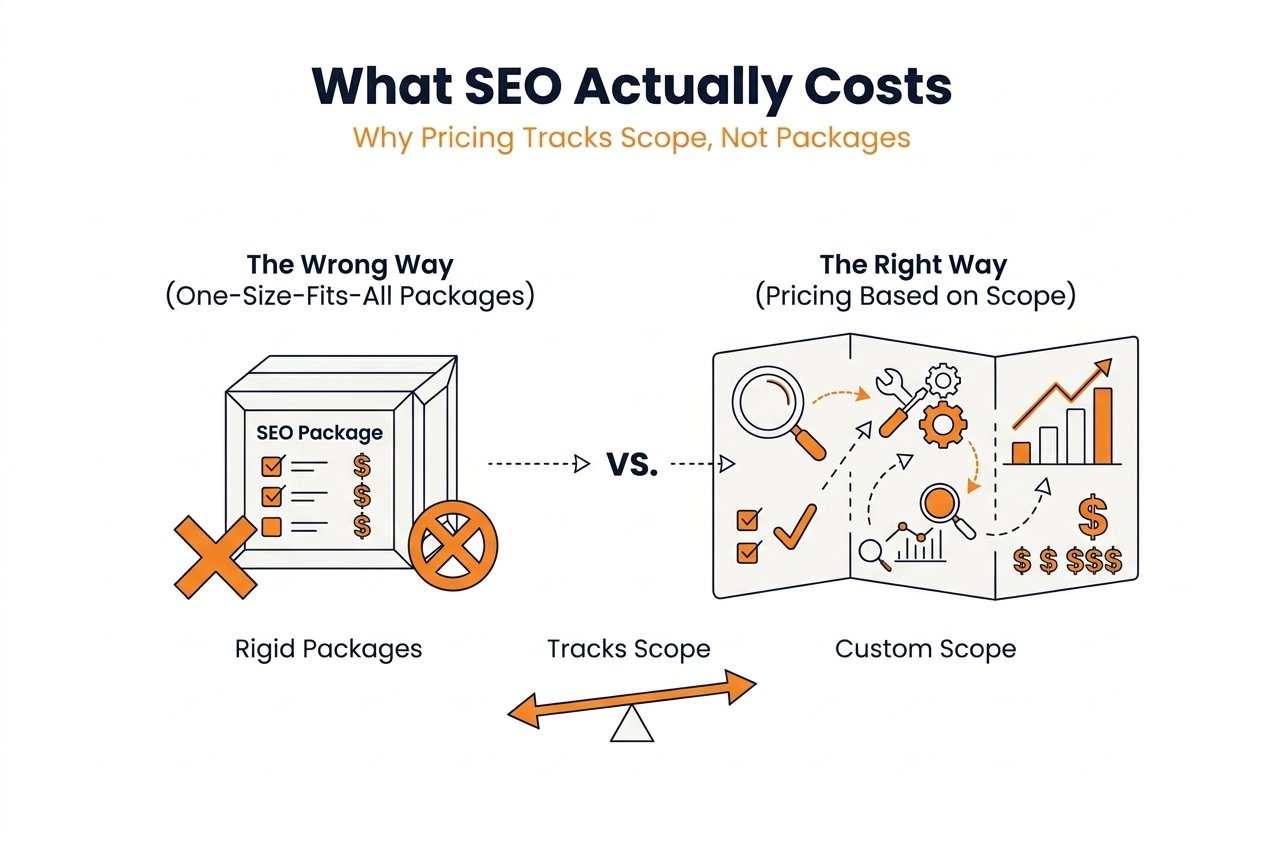
A lot of SEO pricing gets sold in neat tiers — Bronze, Silver, Gold, or "Starter, Growth, Scale" — with a fixed monthly fee regardless of what the site actually needs. Packages like this exist to simplify selling for the agency. They don't exist because they match the needs of any particular site.
The tell is usually in what's included. A fixed package promising "10 blog posts, 20 backlinks, and monthly reporting" for every client, whether that client is a five-page local business site or a 5,000-page SaaS platform, isn't pricing based on scope. It's pricing based on what fits neatly on a sales page.
That doesn't automatically make packaged pricing a scam — for some very small, simple sites, a fixed package genuinely covers what's needed. The problem is when it's used as the only pricing model regardless of the site in front of it, because at that point the price has stopped tracking the work.
How to Read a Quote
A few questions cut through most of the confusion when comparing proposals:
Is this a one-time engagement or ongoing management? Confirm you're comparing like with like before comparing numbers.
What's actually included in implementation? Recommendations only, or hands-on fixes? A cheaper quote that only delivers a report can end up costing more once you account for a developer's time to act on it.
Was the scope based on an assessment of your site, or handed to you before anyone looked at it? A quote produced without ever reviewing your actual technical condition and content isn't sized to your situation — it's a template.
Does the proposal explain why the price is what it is? A number with no rationale is harder to trust than a number tied to a specific list of findings and the effort each one requires.
What happens if the scope turns out to be wrong? Sites sometimes have hidden problems that only surface once work starts. A fair engagement has a way to handle that without silently expanding the invoice.
The Better Question
The question worth asking isn't whether an agency is cheap or premium. It's whether the proposed scope matches your actual situation, and whether the work inside that scope is prioritized rather than padded to look comprehensive. A quote for a comprehensive-sounding forty-item list of deliverables is not automatically more valuable than a smaller, sharper quote that targets the five things that will actually move the needle this quarter.
Scope-driven pricing paired with honest prioritization is what a fair SEO engagement looks like, whatever the resulting number turns out to be.
FAQ
Why did one agency quote me $600/month and another quote $6,000/month for the same site?
Ask what's included in each. Often the cheaper quote is recommendations-only with no implementation, a narrower keyword set, or reporting without ongoing strategy work. The expensive quote may include hands-on execution across a much broader scope. They're rarely actually pricing the same work.
Should I pay for a one-time audit or ongoing management?
It depends on where your site stands. A site with a specific, bounded set of problems and an in-house team that can implement fixes may only need a one-time audit. A site that needs continuous attention — regular content, evolving technical issues, competitive tracking — needs ongoing management. Buying ongoing management for a site that only needed a single audit means paying for work that isn't there yet.
Is a low price always a red flag?
Not always, but a price with no connection to your site's actual condition is worth questioning, whether it's low or high. A quote produced before anyone assessed your site's technical state or competitive landscape isn't really a quote — it's a guess dressed up as one.
Can a small business realistically afford good SEO?
Yes, if the scope is sized to the business. A small business fixing a handful of foundational issues and targeting a realistic set of keywords costs meaningfully less than an enterprise engagement spanning multiple markets, because the work involved is genuinely smaller — not because the quality is lower.
How do I know if I'm being overcharged?
Ask for the reasoning behind the number: what was assessed, what's being prioritized, and why each line item costs what it does. An agency that can walk you through that is pricing based on your site. One that can't, and just points back to a package tier, may be pricing based on what's easiest to sell.
SEO pricing that seems inconsistent across agencies usually isn't a sign of an unserious industry — it's a sign that "SEO" covers a wide range of actual work, and the price should move with the scope. The right question isn't affordable versus premium. It's whether the number in front of you reflects an honest look at what your site actually needs.
If you want a quote based on your site rather than a tier on a pricing page, start with a free SEO assessment. We'll tell you what's actually worth fixing, and price the work behind it — not a package.
Related Guides
More from the same part of the roadmap — same category first, newest first.